 Add to Chrome
 Add to Firefox
 Add to Edge
A Closed-Form CLF-CBF Controller for Whole-Body Continuum Soft Robot Collision Avoidance
Mar 19, 2026
Safe operation is essential for deploying robots in human-centered 3D environments. Soft continuum manipulators provide passive safety through mechanical compliance, but still require active control to achieve reliable collision avoidance. Existing approaches, such as sampling-based planning, are often computationally expensive and lack formal safety guarantees, which limits their use for real-time whole-body avoidance. This paper presents a closed-form Control Lyapunov Function--Control Barrier Function (CLF--CBF) controller for real-time 3D obstacle avoidance in soft continuum manipulators without online optimization. By analytically embedding safety constraints into the control input, the proposed method ensures stability and safety under the stated modeling assumptions, while avoiding feasibility issues commonly encountered in online optimization-based methods. The resulting controller is up to $10\times$ faster than standard CLF--CBF quadratic-programming approaches and up to $100\times$ faster than traditional sampling-based planners. Simulation and hardware experiments on a tendon-driven soft manipulator demonstrate accurate 3D trajectory tracking and robust obstacle avoidance in cluttered environments. These results show that the proposed framework provides a scalable and provably safe control strategy for soft robots operating in dynamic, safety-critical settings.

BarrierSteer: LLM Safety via Learning Barrier Steering
Feb 23, 2026Despite the state-of-the-art performance of large language models (LLMs) across diverse tasks, their susceptibility to adversarial attacks and unsafe content generation remains a major obstacle to deployment, particularly in high-stakes settings. Addressing this challenge requires safety mechanisms that are both practically effective and supported by rigorous theory. We introduce BarrierSteer, a novel framework that formalizes response safety by embedding learned non-linear safety constraints directly into the model's latent representation space. BarrierSteer employs a steering mechanism based on Control Barrier Functions (CBFs) to efficiently detect and prevent unsafe response trajectories during inference with high precision. By enforcing multiple safety constraints through efficient constraint merging, without modifying the underlying LLM parameters, BarrierSteer preserves the model's original capabilities and performance. We provide theoretical results establishing that applying CBFs in latent space offers a principled and computationally efficient approach to enforcing safety. Our experiments across multiple models and datasets show that BarrierSteer substantially reduces adversarial success rates, decreases unsafe generations, and outperforms existing methods.
Robust Taylor-Lagrange Control for Safety-Critical Systems
Feb 23, 2026Solving safety-critical control problem has widely adopted the Control Barrier Function (CBF) method. However, the existence of a CBF is only a sufficient condition for system safety. The recently proposed Taylor-Lagrange Control (TLC) method addresses this limitation, but is vulnerable to the feasibility preservation problem (e.g., inter-sampling effect). In this paper, we propose a robust TLC (rTLC) method to address the feasibility preservation problem. Specifically, the rTLC method expands the safety function at an order higher than the relative degree of the function using Taylor's expansion with Lagrange remainder, which allows the control to explicitly show up at the current time instead of the future time in the TLC method. The rTLC method naturally addresses the feasibility preservation problem with only one hyper-parameter (the discretization time interval size during implementation), which is much less than its counterparts. Finally, we illustrate the effectiveness of the proposed rTLC method through an adaptive cruise control problem, and compare it with existing safety-critical control methods.
Mixture-of-World Models: Scaling Multi-Task Reinforcement Learning with Modular Latent Dynamics
Feb 01, 2026A fundamental challenge in multi-task reinforcement learning (MTRL) is achieving sample efficiency in visual domains where tasks exhibit substantial heterogeneity in both observations and dynamics. Model-based reinforcement learning offers a promising path to improved sample efficiency through world models, but standard monolithic architectures struggle to capture diverse task dynamics, resulting in poor reconstruction and prediction accuracy. We introduce Mixture-of-World Models (MoW), a scalable architecture that combines modular variational autoencoders for task-adaptive visual compression, a hybrid Transformer-based dynamics model with task-conditioned experts and a shared backbone, and a gradient-based task clustering strategy for efficient parameter allocation. On the Atari 100k benchmark, a single MoW agent trained once on 26 Atari games achieves a mean human-normalized score of 110.4%, competitive with the score of 114.2% achieved by STORM, an ensemble of 26 task-specific models, while using 50% fewer parameters. On Meta-World, MoW achieves a 74.5% average success rate within 300 thousand environment steps, establishing a new state of the art. These results demonstrate that MoW provides a scalable and parameter-efficient foundation for generalist world models.
PoSafeNet: Safe Learning with Poset-Structured Neural Nets
Jan 29, 2026Safe learning is essential for deploying learningbased controllers in safety-critical robotic systems, yet existing approaches often enforce multiple safety constraints uniformly or via fixed priority orders, leading to infeasibility and brittle behavior. In practice, safety requirements are heterogeneous and admit only partial priority relations, where some constraints are comparable while others are inherently incomparable. We formalize this setting as poset-structured safety, modeling safety constraints as a partially ordered set and treating safety composition as a structural property of the policy class. Building on this formulation, we propose PoSafeNet, a differentiable neural safety layer that enforces safety via sequential closed-form projection under poset-consistent constraint orderings, enabling adaptive selection or mixing of valid safety executions while preserving priority semantics by construction. Experiments on multi-obstacle navigation, constrained robot manipulation, and vision-based autonomous driving demonstrate improved feasibility, robustness, and scalability over unstructured and differentiable quadratic program-based safety layers.
Taylor-Lagrange Control for Safety-Critical Systems
Dec 12, 2025This paper proposes a novel Taylor-Lagrange Control (TLC) method for nonlinear control systems to ensure the safety and stability through Taylor's theorem with Lagrange remainder. To achieve this, we expand a safety or stability function with respect to time along the system dynamics using the Lie derivative and Taylor's theorem. This expansion enables the control input to appear in the Taylor series at an order equivalent to the relative degree of the function. We show that the proposed TLC provides necessary and sufficient conditions for system safety and is applicable to systems and constraints of arbitrary relative degree. The TLC exhibits connections with existing Control Barrier Function (CBF) and Control Lyapunov Function (CLF) methods, and it further extends the CBF and CLF methods to the complex domain, especially for higher order cases. Compared to High-Order CBFs (HOCBFs), TLC is less restrictive as it does not require forward invariance of the intersection of a set of safe sets while HOCBFs do. We employ TLC to reformulate a constrained optimal control problem as a sequence of quadratic programs with a zero-order hold implementation method, and demonstrate the safety of zero-order hold TLC using an event-triggered control method to address inter-sampling effects. Finally, we illustrate the effectiveness of the proposed TLC method through an adaptive cruise control system and a robot control problem, and compare it with existing CBF methods.
Safe Motion Planning and Control Using Predictive and Adaptive Barrier Methods for Autonomous Surface Vessels
Oct 01, 2025Safe motion planning is essential for autonomous vessel operations, especially in challenging spaces such as narrow inland waterways. However, conventional motion planning approaches are often computationally intensive or overly conservative. This paper proposes a safe motion planning strategy combining Model Predictive Control (MPC) and Control Barrier Functions (CBFs). We introduce a time-varying inflated ellipse obstacle representation, where the inflation radius is adjusted depending on the relative position and attitude between the vessel and the obstacle. The proposed adaptive inflation reduces the conservativeness of the controller compared to traditional fixed-ellipsoid obstacle formulations. The MPC solution provides an approximate motion plan, and high-order CBFs ensure the vessel's safety using the varying inflation radius. Simulation and real-world experiments demonstrate that the proposed strategy enables the fully-actuated autonomous robot vessel to navigate through narrow spaces in real time and resolve potential deadlocks, all while ensuring safety.
Integrating Trajectory Optimization and Reinforcement Learning for Quadrupedal Jumping with Terrain-Adaptive Landing
Sep 16, 2025Jumping constitutes an essential component of quadruped robots' locomotion capabilities, which includes dynamic take-off and adaptive landing. Existing quadrupedal jumping studies mainly focused on the stance and flight phase by assuming a flat landing ground, which is impractical in many real world cases. This work proposes a safe landing framework that achieves adaptive landing on rough terrains by combining Trajectory Optimization (TO) and Reinforcement Learning (RL) together. The RL agent learns to track the reference motion generated by TO in the environments with rough terrains. To enable the learning of compliant landing skills on challenging terrains, a reward relaxation strategy is synthesized to encourage exploration during landing recovery period. Extensive experiments validate the accurate tracking and safe landing skills benefiting from our proposed method in various scenarios.
Robust Online Residual Refinement via Koopman-Guided Dynamics Modeling
Sep 16, 2025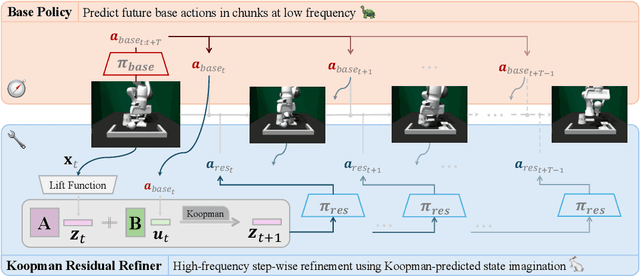
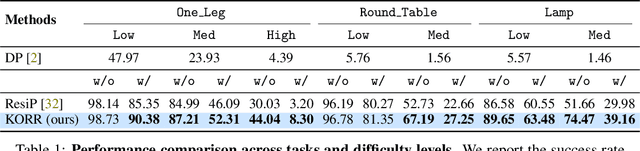
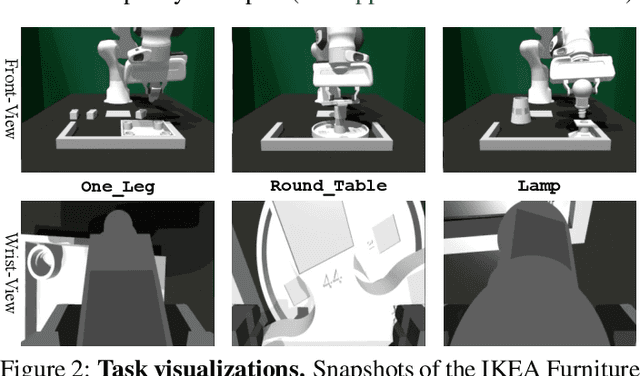
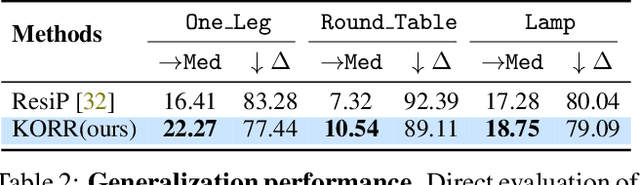
Imitation learning (IL) enables efficient skill acquisition from demonstrations but often struggles with long-horizon tasks and high-precision control due to compounding errors. Residual policy learning offers a promising, model-agnostic solution by refining a base policy through closed-loop corrections. However, existing approaches primarily focus on local corrections to the base policy, lacking a global understanding of state evolution, which limits robustness and generalization to unseen scenarios. To address this, we propose incorporating global dynamics modeling to guide residual policy updates. Specifically, we leverage Koopman operator theory to impose linear time-invariant structure in a learned latent space, enabling reliable state transitions and improved extrapolation for long-horizon prediction and unseen environments. We introduce KORR (Koopman-guided Online Residual Refinement), a simple yet effective framework that conditions residual corrections on Koopman-predicted latent states, enabling globally informed and stable action refinement. We evaluate KORR on long-horizon, fine-grained robotic furniture assembly tasks under various perturbations. Results demonstrate consistent gains in performance, robustness, and generalization over strong baselines. Our findings further highlight the potential of Koopman-based modeling to bridge modern learning methods with classical control theory.
Efficient Online RL Fine Tuning with Offline Pre-trained Policy Only
May 22, 2025Improving the performance of pre-trained policies through online reinforcement learning (RL) is a critical yet challenging topic. Existing online RL fine-tuning methods require continued training with offline pretrained Q-functions for stability and performance. However, these offline pretrained Q-functions commonly underestimate state-action pairs beyond the offline dataset due to the conservatism in most offline RL methods, which hinders further exploration when transitioning from the offline to the online setting. Additionally, this requirement limits their applicability in scenarios where only pre-trained policies are available but pre-trained Q-functions are absent, such as in imitation learning (IL) pre-training. To address these challenges, we propose a method for efficient online RL fine-tuning using solely the offline pre-trained policy, eliminating reliance on pre-trained Q-functions. We introduce PORL (Policy-Only Reinforcement Learning Fine-Tuning), which rapidly initializes the Q-function from scratch during the online phase to avoid detrimental pessimism. Our method not only achieves competitive performance with advanced offline-to-online RL algorithms and online RL approaches that leverage data or policies prior, but also pioneers a new path for directly fine-tuning behavior cloning (BC) policies.